Why We Repeat the Same Relationship Patterns
Have you ever found yourself wondering why you keep ending up in the same kind of relationship, even though the people involved look completely different?
Perhaps you keep falling for people who are emotionally unavailable. Maybe you find yourself becoming the one who gives more, tries harder, waits longer, rescues, fixes, or puts your own needs aside in the hope that things will eventually change. You tell yourself this relationship will be different. This time you'll be more careful. This time you'll spot the warning signs earlier. This time you'll finally choose someone who can truly meet you where you are.
And yet, somehow, you find yourself back in a place that feels painfully familiar.
The details may change, but the emotional experience remains much the same. Maybe you feel unseen, unwanted, unimportant or alone; perhaps you're constantly worrying that you've done something wrong, trying to earn love, approval or reassurance; or maybe you're losing sight of your own needs as you become increasingly preoccupied with someone else's.
Eventually you begin asking yourself the question so many people ask in therapy:
"Why does this keep happening to me?"
It's easy to conclude that you've simply had bad luck in relationships, or that you just keep choosing the wrong people. Sometimes that's true. But very often, we're not repeating the relationship. We're repeating the pattern.
It's Easy to Believe We're Just Choosing the Wrong People
When the same painful experiences keep repeating, the simplest explanation is that we’ve just been unlucky.
Maybe we keep choosing the wrong people. Maybe we’ve missed warning signs or stayed longer than we should have.
So we promise ourselves that next time will be different. We’ll spot the red flags sooner, choose someone else and leave before things get worse. Sometimes that is exactly what needs to happen.
But when the emotional experience remains much the same across different relationships, there may be more to it than that.
Why does this kind of dynamic feel so familiar? Why are certain people so compelling, even when they leave us feeling hurt, unseen or emotionally exhausted? Why do we tolerate things we would never want for someone we love?
These are difficult questions, but they are not questions of blame. Often, something deeper is happening than simply choosing the “wrong” person.
We Rarely Repeat the Relationship. We Repeat the Pattern.
When we look back over our relationships, it’s easy to focus on the differences: different people, personalities, circumstances and endings.
Yet the emotional experience can feel remarkably familiar. One relationship leaves us uncertain, another feeling that we’re not quite enough. The circumstances change, but the disappointment, loneliness, anxiety or fear of abandonment remain.
It can feel as though we’re reading different books and somehow reaching the same ending.
That doesn’t mean we’re consciously choosing pain, or that there’s something wrong with us. More often, we’re drawn towards what feels familiar, even when that familiarity comes with suffering.
Until we begin to understand the pattern itself, it’s easy to believe the next relationship will be different simply because the person is different. Sometimes it is, at least at first.
But when the underlying pattern remains unchanged, we can find ourselves arriving at the same emotional place by a different route.
These Patterns Often Begin Long Before Our Adult Relationships
None of us enters adulthood with a blank slate. Long before our first romantic relationship, we’re already learning what love, safety, closeness, conflict and trust feel like—and what we need to do to remain accepted.
As children, we adapt remarkably well to the environments we grow up in. If love feels conditional, we may learn to earn it. If our emotional needs aren’t met, we may stop expressing them. If conflict feels unsafe, we may become the peacemaker. If we’re expected to look after other people’s feelings, we may gradually lose touch with our own.
These adaptations are not evidence that something is wrong with us. They are often ingenious ways of surviving the circumstances we found ourselves in.
The difficulty is that the strategies which once helped us survive do not always serve us well in adult relationships. What once protected us can later shape who we choose, what we tolerate and how we respond when closeness begins to feel uncertain.
Why Familiar Can Feel Safer Than Healthy
One of the hardest things to understand is that we do not always choose relationships because they make us happy. More often, we are drawn towards dynamics that feel familiar.
That familiarity is rarely conscious. We do not meet someone and think, “They remind me of my childhood wounds.” Something about the relationship simply feels recognisable. It feels like home, even when home was not always a safe place to be.
If we grew up believing we had to earn love, we may be drawn to people whose affection always feels slightly out of reach. If we learned that our needs came second, we may continue putting other people first. If closeness was unpredictable, we may find ourselves constantly trying to work out where we stand.
This is not because we enjoy suffering. Our nervous system can confuse familiarity with safety.
The patterns that helped us survive in childhood can become the patterns we recreate in adulthood, even when they repeatedly leave us feeling hurt, lonely or unseen.
What feels familiar does not have to determine what happens next. Once we begin to recognise the pattern, we have a chance to respond differently.
How These Patterns Shape Our Relationships
The patterns we develop in childhood don't disappear when we become adults. More often, they quietly shape the way we relate to ourselves and to the people we love.
You may find yourself putting your partner's needs ahead of your own, whilst barely noticing that your own needs have disappeared from the relationship.
You might struggle to say no, fearing that setting a boundary will disappoint someone, create conflict, or even lead to rejection.
Perhaps your sense of worth becomes tied to being needed, helpful, or indispensable. You may feel responsible for keeping the relationship together, fixing problems, or managing another person's emotions, even when those things are beyond your control.
You may find yourself constantly second-guessing your own thoughts, feelings, or instincts. Rather than trusting your own experience, you look to your partner to tell you whether you're overreacting, being unreasonable, or whether your feelings are even valid. Perhaps you apologise for things that aren't your responsibility, minimise your own hurt, or convince yourself that you're "making a fuss" when something genuinely doesn't feel okay.
When emotions run high, you might bottle things up for weeks, telling yourself everything is fine, until eventually it all comes spilling out at once. Or you may suppress your feelings altogether because expressing them feels too risky.
Over time, it can become difficult to know where you end and another person begins. Their moods become your moods. Their approval determines how you feel about yourself. Their distance feels unbearable, whilst their acceptance brings temporary relief. It can become difficult to know what you genuinely think, feel, want, or need as your own reality gradually becomes blurred by someone else's. When this happens, it can become difficult to recognise where your emotional boundaries end and another person's begin.
The Dance We Can Find Ourselves In
None of this means there's something wrong with you.
These are often understandable ways of relating that developed much earlier in life, when staying connected to the important people around us felt essential.
One way of understanding these relationship patterns is through the lens of codependency. If you've recognised yourself in what you've been reading, you may find it helpful to read more about the five core symptoms of codependency and the developmental model that has greatly influenced my understanding of how these patterns develop.
One of the most painful aspects of these relationship patterns is that they often seem to recreate themselves between two people.
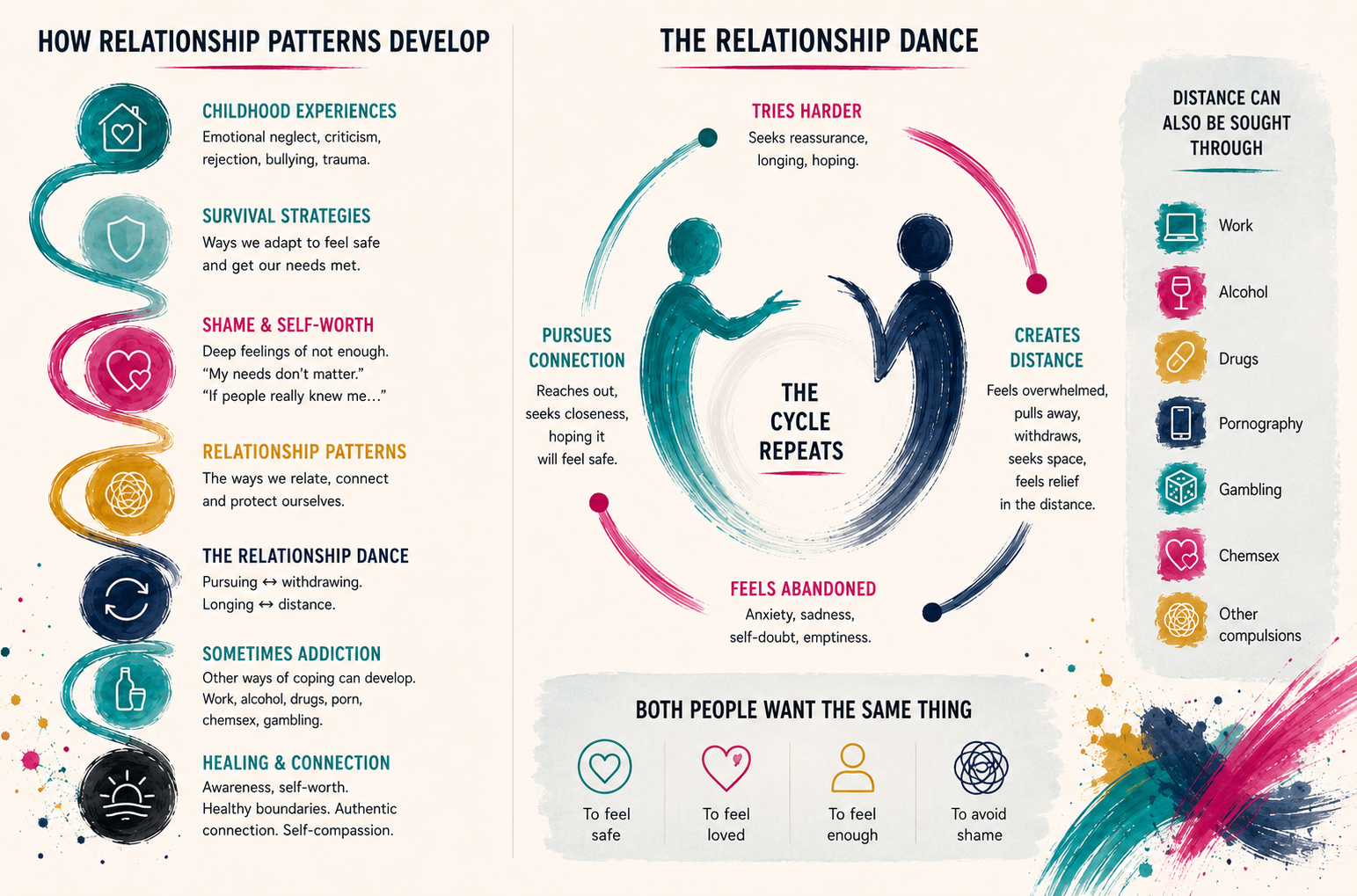
Without realising it, we can find ourselves drawn towards people whose own relationship patterns fit remarkably well with ours. It can feel as though we've finally found "the one", when in reality we've found someone whose way of relating quietly reinforces our own. What begins as chemistry can gradually become a painful cycle in which both people unintentionally reinforce each other's fears, expectations, and ways of protecting themselves.
One person may long for greater closeness, reassurance, and connection. They may find themselves trying harder, waiting longer, overlooking warning signs, or holding onto the hope that things will eventually change. Sometimes they're not relating to the person as they truly are, but to the person they dream they could become if only they felt loved enough, safe enough, or understood enough.
The other person may genuinely want intimacy too, but find themselves becoming overwhelmed as the relationship deepens. Closeness can start to feel like pressure. They may find themselves pulling away, becoming emotionally unavailable, finding fault, throwing themselves into work or other distractions, or creating emotional distance without fully understanding why.
The more one person reaches out, the more the other withdraws. The more the other withdraws, the more desperately the first tries to reconnect. Without either person fully realising it, the relationship can become less about who the other person really is, and more about old patterns, old expectations, and old ways of trying to feel safe, loved, or protected.
Both people are suffering, and neither is intentionally creating the dynamic. Each is responding to old fears in the way they learned to. These patterns do not mean that someone is manipulative, incapable of love or “broken”. They once made sense, even if they now create pain.
What's perhaps less well understood is that we don't always occupy the same role. Some people find themselves repeating one pattern throughout their relationships. Others move between the two. They may desperately pursue closeness in one relationship, only to find themselves creating distance in the next. Sometimes both patterns can even appear within the same relationship.
Understanding this dance isn't about blaming ourselves or our partners. It's about becoming curious about the ways we've learned to protect ourselves, and recognising that there may be another way of relating.
When Relationships Aren't Enough
For many of us, relationships become another way of trying to soothe old feelings of shame, loneliness, abandonment, or not being enough. We hope that if we can finally find the right person, we'll feel complete, safe, or worthy. But no relationship, however loving or healthy, can permanently heal wounds that developed long before that relationship began.
For some people, particularly when intimacy begins to feel overwhelming, addictive behaviours can gradually become another relationship. Without fully realising it, they begin leaving the relationship emotionally rather than physically—turning instead towards work, alcohol, drugs, pornography, gambling, or chemsex to create distance, regulate difficult feelings, or regain a sense of control.
Over time, relationships and addictive behaviours can begin serving the same purpose: helping us manage feelings that once felt too overwhelming to experience.
This is one of the reasons I believe addiction is rarely just about the substance or the behaviour itself. More often, it's another attempt to cope with wounds that developed much earlier in life.
Breaking the Pattern
It’s tempting to believe that the answer is simply to find a different partner. Sometimes it is. But when the underlying pattern remains unchanged, we can end up recreating the same emotional experience with someone new.
The pattern does not live only in the other person. It also lives in the ways we’ve learned to protect ourselves.
Many people come to therapy believing they have a “faulty picker”. More often, it is not that they cannot recognise a healthy person, but that certain relationship dynamics feel more familiar and therefore more compelling.
Our wounds can make someone feel exciting, irresistible or as though we’ve finally found “the one”. A healthier relationship may initially feel unfamiliar, uncomfortable or even a little boring—not because it lacks something, but because it does not activate the same old uncertainty.
These patterns are not fixed. As we begin to heal shame, understand what we’ve been repeating and develop a healthier relationship with ourselves, we become able to respond differently within relationships. We may also begin choosing differently in the first place.
The goal is not to become someone else. It is to understand how we learned to protect ourselves, recognise why those strategies were once necessary, and consider whether they are still serving us now.
These patterns did not develop because there was something wrong with us. They were learned, and what was learned can also be unlearned.
Through understanding, self-compassion and the safety of a healing relationship, it is possible to create new patterns rather than continuing to repeat old ones.
Written by Dan Lee
Therapist working with men and LGBTQ+ clients around addiction, shame, codependency and identity.
About Dan
If you’re tired of ending up in the same emotional place and want help understanding what keeps taking you there, get in touch and we can set up a brief phone chat to explore working together.